
Should Your Farm Own the Asset—or Pay for the Result?
A tractor, milk cooler, irrigation pump, delivery vehicle or processing machine should earn its place in the business. Compare buying, leasing, hiring and partnering before committing the farm's capital.
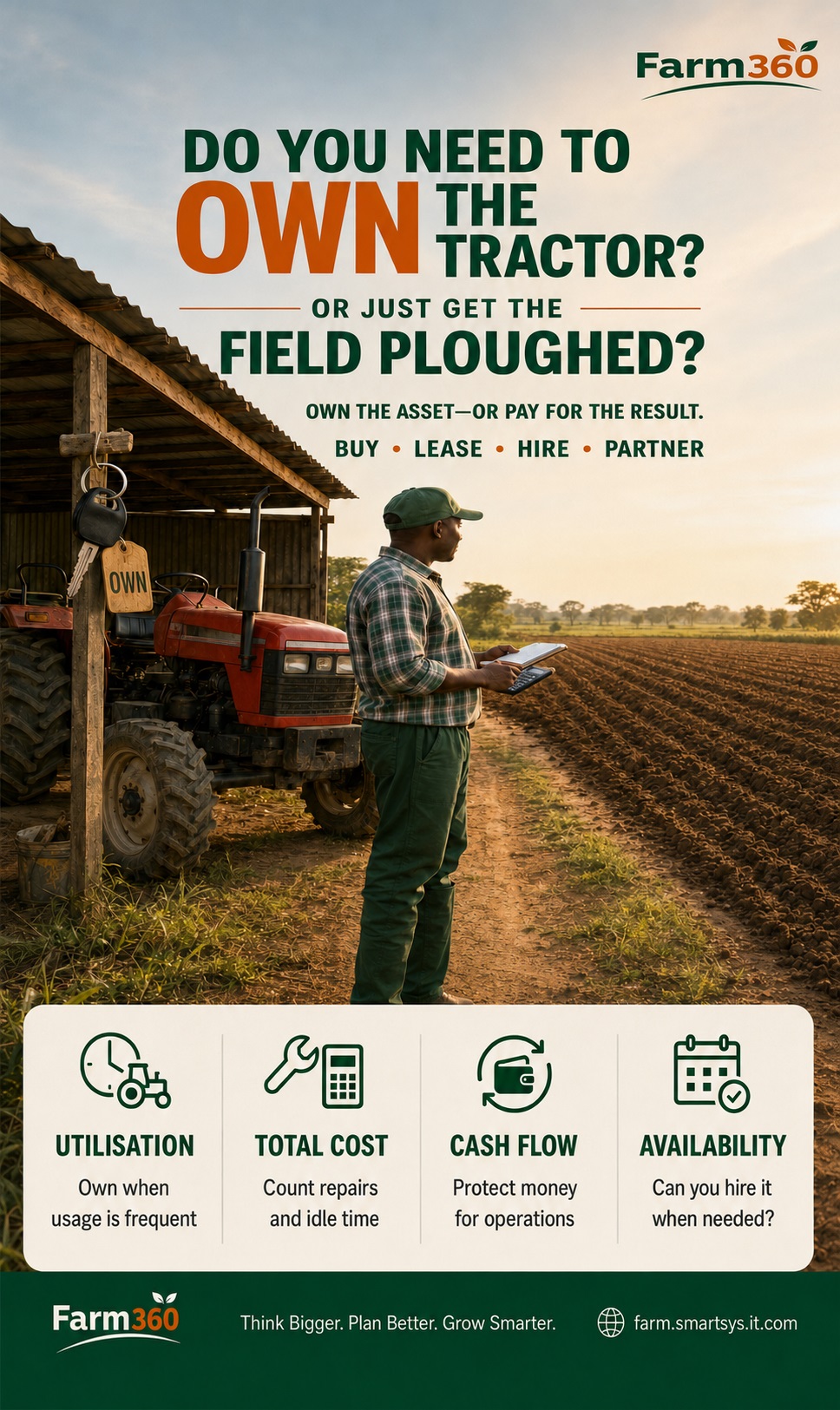
Start with the result the farm needs
A farm asset is valuable when it improves production, reduces a cost, protects quality, saves time or creates dependable income. Ownership can give a farmer control and long-term capacity. It also brings finance commitments, maintenance, repairs, insurance, storage and periods when the asset may not be working.
Hiring equipment or paying a provider for the completed service can preserve capital and transfer much of the operating burden. Leasing spreads access over an agreed period. A partnership can distribute ownership and use among several farms. Each approach has a different effect on cost, timing, control and risk.
The tractor in the photograph makes the question easy to see, but the same decision applies to irrigation pumps, dairy equipment, feed mixers, chaff cutters, generators, cold rooms, delivery vehicles, solar systems and processing machinery. Start with what the farm needs to achieve, how often, by when and at what full cost.
Four tests before you commit
Put your farm's numbers around the decision
These four questions turn a large asset decision into a comparison you can explain, review and improve.
Utilisation
How often will the asset earn or save money?
Count the productive hours, jobs, units or months in which it will be used—not only the busiest period.
Total cost
What will each useful hour or unit cost?
Include finance, energy, operators, servicing, repairs, consumables, insurance, storage, security and idle time.
Cash flow
What else must the farm fund?
Protect working capital for seed, feed, fertiliser, labour, animal health, irrigation, harvesting and market delivery.
Availability
Can the work be done on time?
A low hire price has limited value if the asset is unavailable when production, delivery or processing needs it.
1. Estimate productive utilisation
List every productive use of the asset. A pump can be measured by irrigation hours or acres served; a milk cooler by litres protected; a vehicle by deliveries; and processing equipment by kilograms or units handled. Include the period in which each use must happen.
- Use within your own farm enterprises
- Peak and off-season demand
- Paid work or services for other farms
- Idle time, downtime and unused capacity
Count work the farm can reasonably secure—not work that might become available. Contracting for other farmers can strengthen utilisation, but it also adds scheduling, operators, administration, transport, collection and wear costs.
2. Compare the full cost per useful unit
The instalment is not the full cost of an asset, and a quoted hire or service rate may not be the final cost of the result. Put every option on the same basis: per hour, acre, litre, kilogram, delivery, animal, batch or production cycle.
Annual ownership cost
Finance or depreciation + insurance + storage and security + scheduled service + expected repairs
True cost per useful unit
Annual ownership cost ÷ productive units + energy + operator + consumables + transport cost per unit
When comparing a hire quotation
Confirm exactly what result is included, how usage is measured, and who pays for the operator, energy, transport, installation, consumables and downtime. Ask what may change the price and what happens if the provider cannot meet the agreed date or output.
3. Protect the farm's working capital
An asset can be affordable on paper and still place pressure on seasonal operations. Map the deposit and repayments against the months when the farm must pay for seed, fertiliser, feed, chemicals, labour, animal health, irrigation, harvesting and transport.
Then ask a direct question: after paying for the asset, can the farm still fund the production that makes the asset useful?
4. Give timing a financial value
Hiring can look favourable until demand peaks and every business wants the same equipment or service. Ownership can improve control, but a breakdown at the wrong time can create the same delay. Compare the reliability and consequences of each option, not only its price.
Provider
Does the supplier have a clear booking process, service standard and backup plan?
Asset
Are parts, technical support and a replacement asset accessible?
Farm
Are staff, inputs, power, water and facilities ready when the asset becomes available?
Four ways to access the result
Buy, lease, hire or partner?
None of these options is automatically superior. The strongest fit is the one that delivers dependable work while keeping the whole farm financially healthy.
Buy
Best considered when use is frequent and dependable.
- You have regular work across the year or several enterprises.
- The farm can fund ownership without weakening seasonal operations.
- A trained operator, servicing and secure storage are available.
- You may earn additional income from carefully planned contract work.
Lease or finance
Useful when the farm needs reliable access but wants to spread payment.
- Repayments fit the farm's realistic cash-flow cycle.
- The total repayment and all fees are clear before signing.
- Insurance, service support, warranty and security are understood.
- The asset and any attachments match the actual work required.
Hire the service
Strong option when use is seasonal or the required assets vary.
- A dependable contractor can meet the required dates.
- The quote clearly states the service, operator, energy, transport and other charges.
- Your capital has a stronger role elsewhere in the farm.
- You want the result without carrying maintenance and repair risk.
Partner or share
Can improve access when farmers agree on scheduling and responsibility.
- Demand is large enough across the participating farms.
- Peak operating periods do not create an unmanageable booking conflict.
- Running costs, operators, repairs, storage and outside income are documented.
- There is a fair process for breakdowns, disputes and member exit.
A simple farm asset decision comparison
| Factor | Buy | Lease or finance | Hire | Partner |
|---|---|---|---|---|
| Upfront cash | Usually highest | Deposit plus repayments | Pay per job, hour, unit or season | Shared contribution |
| Control over timing | High when the asset is available and working | High during the lease | Depends on provider availability | Depends on the booking agreement |
| Maintenance responsibility | Mostly yours | Depends on the agreement | Usually the provider's | Shared under written rules |
| Best fit | Frequent, predictable use | Predictable use with staged payment | Seasonal or specialised work | Enough combined use and strong coordination |
If you partner, agree before you buy
Shared ownership through farmers, a cooperative or another structured group can increase utilisation and reduce the burden on one farm. The arrangement needs written operating rules.
- Ownership shares and contributions
- Booking priority during peak weeks
- Approved operators and charge rates
- Running costs, servicing and repair responsibility
- Insurance, security and storage
- Income from work outside the group
- Breakdown and dispute procedure
- Member exit and sale of a share
Before signing for asset finance
Ask the lender or supplier to put the full commitment in writing. Compare more than the monthly or annual instalment.
- 1What is the cash price, deposit and total amount repayable?
- 2Which interest, insurance, valuation, legal and processing charges apply?
- 3Do repayment dates match the farm's production and sales cycle?
- 4Are all attachments, accessories and installation costs included?
- 5Who provides servicing, parts, warranty support and operator training?
- 6What happens after a late payment, breakdown or early settlement?
This article offers general planning information, not individual financial advice. Confirm current prices, lending terms, insurance, tax treatment and legal arrangements with qualified Kenyan providers before committing.
Decide from your farm records
Let the numbers show which option fits
Farm360 brings production activities, operating costs, labour, sales and cash flow into one place. Use those records to compare current service spending, expected utilisation, timing and the cost of each option per useful unit or production cycle.
Frequently asked questions
Buying, leasing and hiring farm assets in Kenya
Is buying a farm asset cheaper than hiring or leasing it?
It depends on how much productive work the asset will do and the full cost of ownership. Buying can be economical at high, consistent utilisation. Hiring can cost less when use is limited or seasonal because the farm does not carry depreciation, finance, repairs, storage and idle-time costs.
How much use justifies buying a farm asset?
There is no single threshold that works for every farm or asset. Capacity, workload, seasonality, expected life, hire rates, finance terms and the value of timely access all affect the answer. Compare annual ownership cost with the real cost and reliability of leasing, hiring or paying for the service.
Which costs should I include before purchasing an asset?
Include the purchase or finance cost, depreciation, interest and fees, insurance, registration where applicable, installation, storage, security, operators, energy, consumables, routine service, repairs, accessories, transport and expected downtime.
Can farmers jointly own an expensive farm asset?
Yes, but the arrangement needs more than goodwill. Put ownership shares, booking priority, operating rules, running costs, servicing, repairs, insurance, storage, outside income and the exit process in a written agreement before purchasing.
How can Farm360 support the decision?
Farm360 helps bring production activity, operating costs, labour, sales and cash-flow records together. These records can show current hire or service spending, utilisation, seasonal timing, cost per unit and whether a purchase or another access model fits the farm's numbers.
Further reading
- Kenya National Agricultural Mechanization Policy 2023 — Ministry of Agriculture and Livestock Development.
- Current agricultural credit information — Agricultural Finance Corporation. Confirm terms directly before applying.