
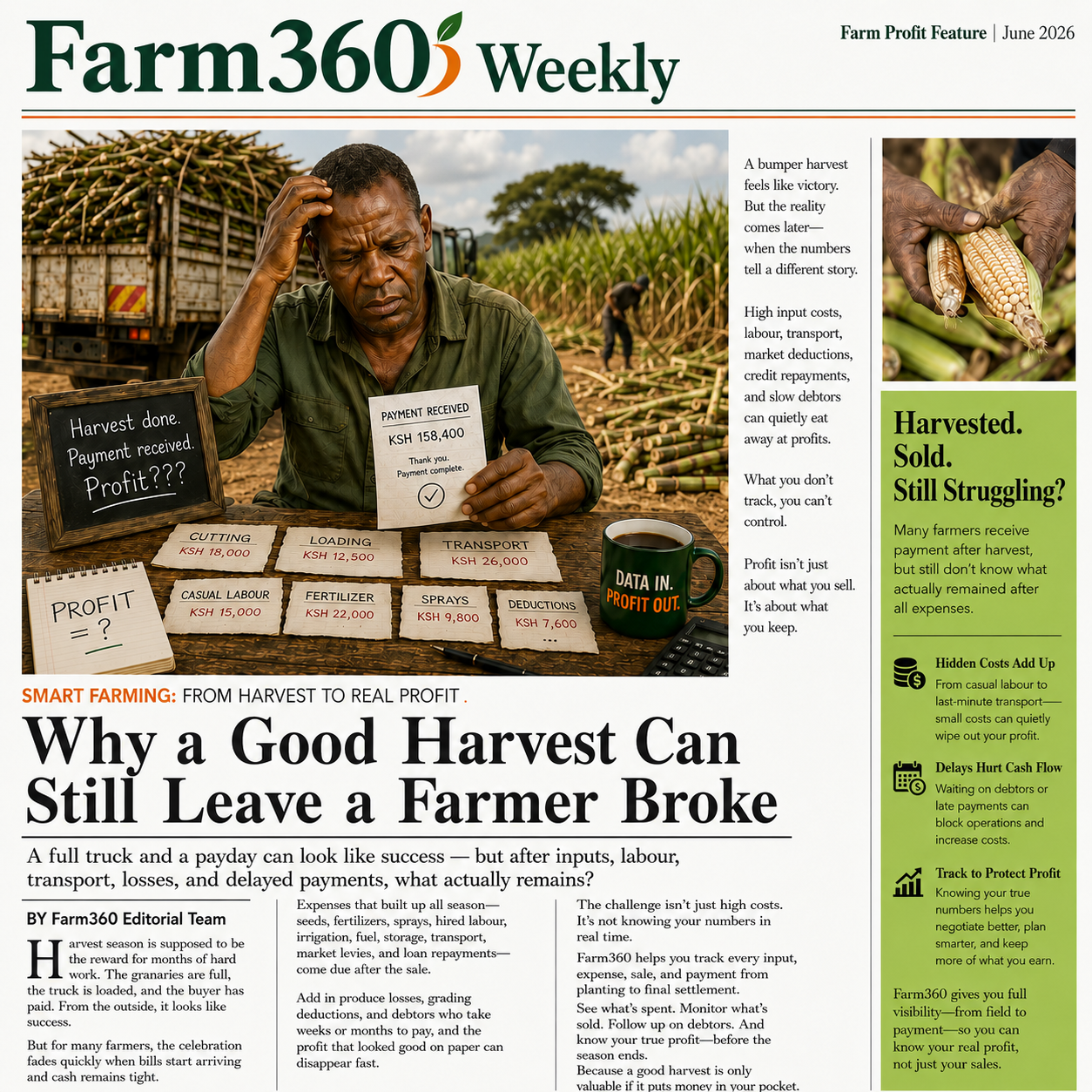
Many farmers celebrate when the harvest looks good. The crop has done well, the truck is full, buyers are calling, workers are busy, and money is finally coming in.
But a good harvest is not always the same as a profitable season. Sometimes, the farmer receives money, pays people, clears debts, buys more inputs, handles family needs, and then realizes there is very little left.
The harvest may be big, but if the costs were bigger, the farm did not really move forward.
The payday trap in farming
Farming has a way of making money feel visible only on payday. When produce is sold, the farmer sees a lump sum and it feels like the season has succeeded. But that money is not yet profit.
Before profit can be known, the farmer must subtract everything that went into producing and selling that harvest. This includes the obvious costs like fertilizer and labour, but also the smaller costs that are easy to forget.
Seeds, fertilizer, sprays, manure, irrigation, and other inputs
Casual labour, harvesting teams, supervision, and preparation work
Transport, loading, weighing, storage, packaging, and market deductions
Credit sales, delayed payments, produce losses, and unrecorded expenses
Why farmers can harvest well and still struggle
A farmer may harvest more this season than last season and still make less money. This can happen when input prices rise, labour costs increase, transport becomes expensive, produce is sold on credit, or market prices fall at the wrong time.
It can also happen when the farmer does not separate farm money from personal money. The farm receives cash, but without proper records, it becomes hard to know what belongs to the business, what should be reinvested, and what can safely be spent.
Simple truth
Sales are not profit. Harvest is not profit. Cash received is not profit.
Profit is what remains after the farmer understands the full cost of production, the real value of sales, unpaid balances, losses, and all farm expenses.
The questions every farmer should ask after harvest
The most important harvest report is not just how many bags, crates, kilos, bunches, trays, or litres were produced. The most important report is whether that production left the farm stronger.
What did it cost to produce?
A harvest only tells part of the story. The farmer must also know the cost of inputs, labour, services, transport, and field activity.
What was actually received?
The payment may look good, but deductions, unpaid balances, rejected produce, and delayed payments can reduce the real value.
What remained after expenses?
Profit is not the money received on payday. Profit is what remains after the full cost of production and selling is known.
Which crop or field performed best?
Without proper records, a farmer may repeat the same activities without knowing which crop, field, season, or buyer was truly profitable.
How Farm360 helps farmers see the real picture
Farm360 helps farmers connect daily farm activity to business performance. Instead of only remembering that a harvest was good, the farmer can record what was planted, what was spent, what was harvested, what was sold, who paid, who still owes, and what profit remained.
This gives the farmer better visibility before making the next decision. Should they plant the same crop again? Should they change the buyer? Was transport too expensive? Did labour take too much? Did credit sales reduce cash flow? These questions become easier to answer when the records are clear.
From hard work to clear decisions
Farmers already work hard. Farm360 does not replace that effort. It helps make the effort visible in numbers, so a farmer can stop guessing and start seeing which activities truly support the farm.
A farm should not only look busy. It should be able to show whether the work, the money, the harvest, and the risks are moving the farmer forward.
Ready to know your real farm profit?
Know your farm. Know your profit.
Farm360 helps farmers track production, expenses, sales, debtors, crop performance, livestock performance, and profit — all in one organized system.